


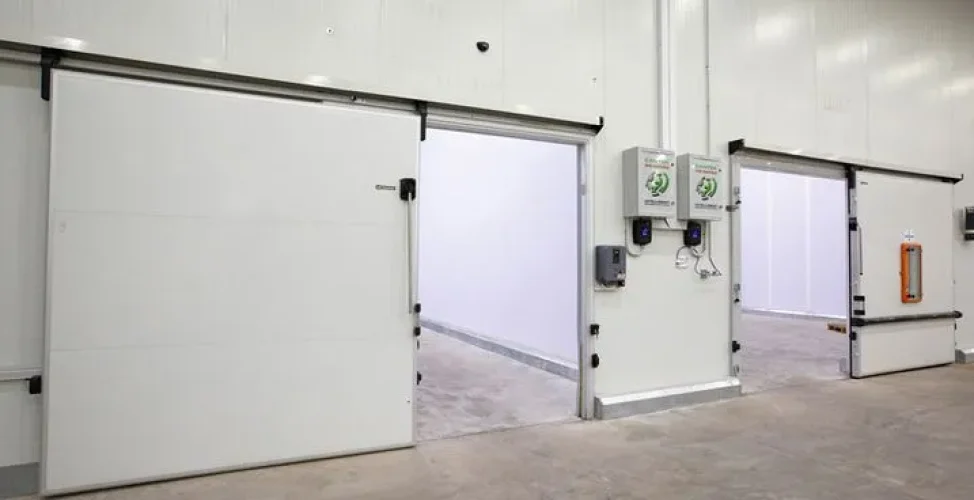
In the UAE Cold Storage sector, two of the most critical KPIs are energy intensity (kWh) and risk exposure. High ambient temperatures, long compressor run-hours, and frequent door openings push refrigeration systems into operating regimes where small design and control decisions translate into measurable utility costs.
At the same time, safety expectations typically verified through civil-defense requirements, project approvals, and third‑party audits extend beyond equipment selection into machinery-room ventilation, refrigerant detection, emergency shutdown logic, electrical classification, and documented operating procedures.
This guide focuses on engineering controls that move both needles: reducing load (infiltration and envelope losses), improving system efficiency (condensing and suction strategy, VFD control, defrost management, heat recovery), and closing compliance gaps (refrigerant safety, fire and life safety interfaces, monitoring and records). You’ll find a practical structure for evaluating an existing facility or specifying a new one what to measure, what auditors typically request, and which retrofit actions deliver the fastest payback under UAE operating conditions.
UAE Cold Storage Regulatory Landscape
From an engineering and EPC standpoint, UAE Cold Storage compliance is not a “single certificate” you obtain at the end of a project it is a chain of design decisions, approvals, and operational controls that starts at concept design and continues through commissioning and day‑to‑day operation. In practice, the same cold store can be technically “working” while still failing a review because the project file does not show how safety risks are controlled (refrigerant hazards, emergency response, electrical protections) or how temperature integrity is verified (monitoring, records, calibration).
What makes the UAE different is the combination of high cooling loads, strict fire/life‑safety oversight, and fast project timelines. If the compliance pathway is not planned early, contractors end up redesigning machine rooms, changing insulation specs, or reworking ventilation and detection layouts late in the project exactly when Cold Storage Facility Cost pressure is highest. The goal of this section is to map the typical approval flow and explain what authorities and auditors usually want to see in a cold storage project file.
Refrigeration Safety Compliance (Ammonia, HFCs, CO₂)
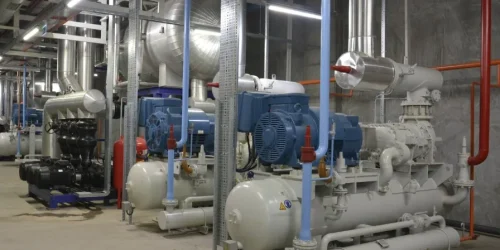
Refrigeration safety is where cold stores most often face tough questions, especially when the plant uses an Ammonia refrigeration system or a cascade/CO₂ configuration. Compliance is not just “choose a refrigerant” — it’s proving that the facility can detect, contain, and respond to a leak scenario without exposing people, product, or neighboring assets. That proof shows up in drawings, cause-and-effect matrices, and commissioning test records.
From an engineering view, three elements must be coherent: detection, ventilation, and isolation. Detection means sensor selection and placement based on leak behavior (where gas will accumulate), not based on neat symmetry in a room. Ventilation means the airflow path actually sweeps the hazard zone, not just “a fan on the wall.” Isolation means the emergency shutdown sequence cuts the right compressors, closes the right valves, and triggers alarms in the right escalation order.
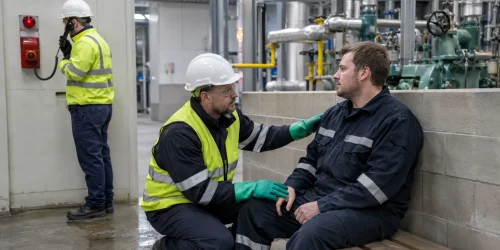
Operationally, safety compliance also depends on training and procedures: who can enter the machinery room, what PPE is required, how alarms are acknowledged, and how maintenance is controlled (LOTO, permits). In UAE projects, auditors and insurers often look for evidence that these controls are not theoretical meaning you need training records, drill notes, and a clear, posted emergency plan that matches the installed system.
Documentation, Testing, and What Auditors Actually Ask For
In UAE Cold Storage audits, the most common failure mode is not catastrophic equipment design it’s missing or inconsistent documentation. Auditors typically want to see that the system’s safety functions and temperature integrity functions are defined, installed, and verified. If you can’t show a traceable chain from design intent → installation → test record, the project is exposed even if the plant “runs.”
At minimum, I recommend a structured deliverable set: as‑built drawings, refrigeration P&IDs, electrical single‑lines, control philosophy, cause‑and‑effect for alarms and ESD, sensor lists with calibration certificates, and commissioning check sheets. For temperature compliance, you also need a monitoring narrative: where sensors are placed, how alarms escalate, how data is retained, and how deviations are handled.
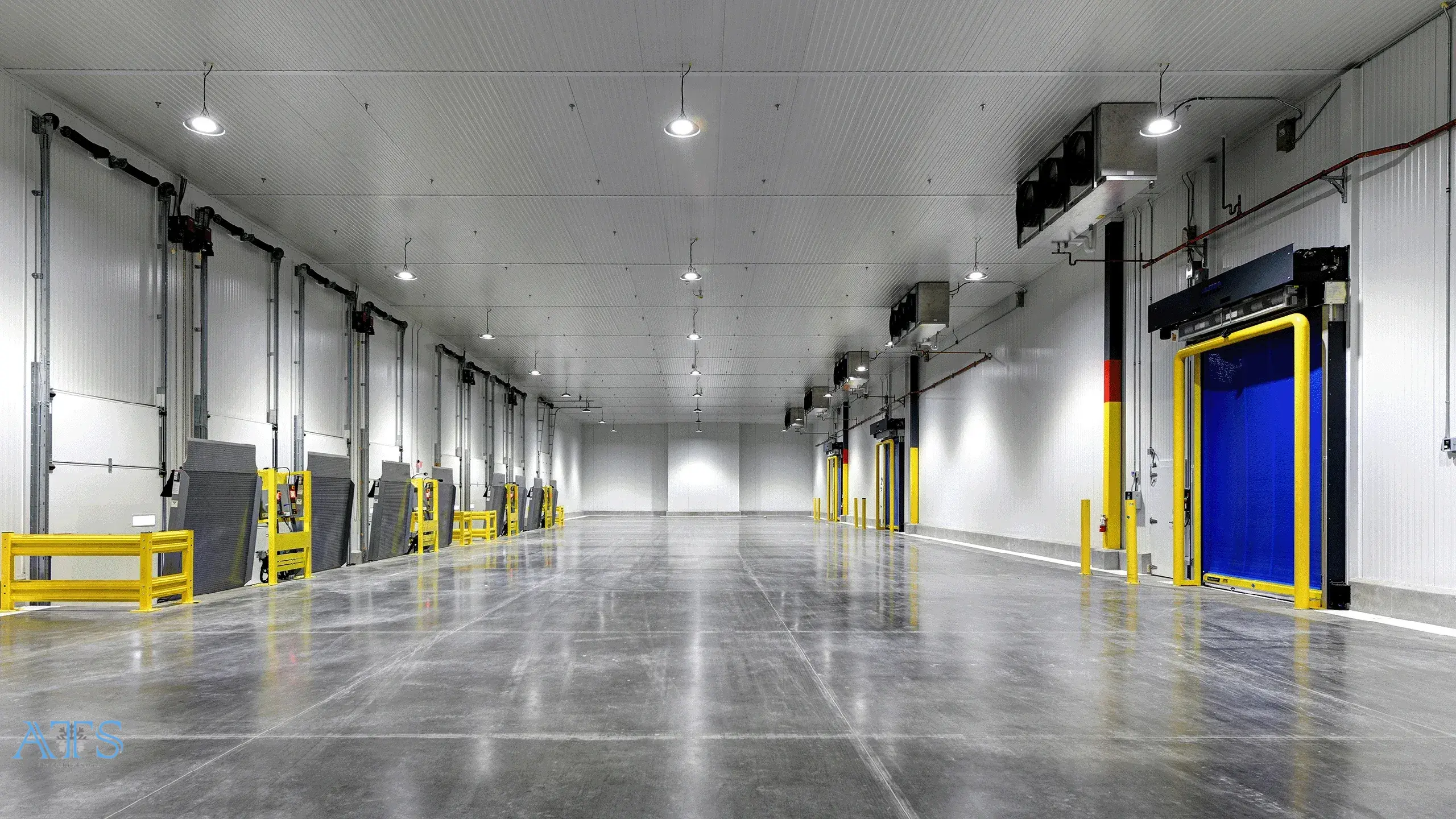
Safety Documentation That Auditors Expect
Auditors don’t fail cold stores because the compressors are the wrong brand; they fail them because the safety story isn’t provable on paper. In a real project, you can have a plant that runs and still get stopped because the documentation doesn’t demonstrate: (1) what the hazards are, (2) what controls you designed/installed, and (3) how you verified those controls work under realistic scenarios.
As a contractor/engineer, the fastest way to pass audits is to treat documentation as part of the deliverable—like piping or wiring—not as a last‑minute “handover binder.” Your safety documents must align across disciplines (refrigeration, electrical, controls, civil, fire & life safety). If your P&IDs say one thing, your Cause & Effect says another, and your as‑built shows a third, an auditor will assume the system is unmanaged.
In UAE projects, auditors typically focus on traceability: design intent → installation evidence → test record → operational control. If you build your safety file around that chain, audits become a review process, not an argument.
Safety Narrative & Hazard Register (Risk-Based “Safety Story”)
A credible safety file starts with a short Safety Narrative: what refrigerant is used, where the highest-risk zones are (machinery room, valve stations, hot work areas), and what the safety philosophy is (detection, ventilation, isolation, alarms, emergency response). This is the document that tells the auditor “we understand the hazards and designed around them,” without making them hunt through drawings.
Next is a Hazard Register / Risk Assessment (HAZID-style or equivalent) that lists hazards (refrigerant release, oxygen displacement, electrical arc, confined spaces, frostbite, pressure relief discharge, vehicle impact), the consequences, existing controls, and residual risk. Auditors don’t expect perfection; they expect a structured approach that matches the actual site conditions and equipment.
Finally, the narrative and register must cross-reference “hard” deliverables: P&IDs, equipment schedules, detector layout, ventilation calculations, ESD logic, and signage/escape plans. If your risk register says “leak detection triggers ESD,” the file must show where detection is, what it triggers, and how it was tested.
Refrigeration P&IDs, Valve Lists, and Relief Discharge Documentation
Auditors commonly start with Refrigeration P&IDs because they reveal whether the system is understandable, maintainable, and isolatable during an incident. Your P&IDs should be “as-built true,” with clear tag numbers, isolation valves, check valves, pressure safety valves (PSVs), purge points, and service connections. Any mismatch between installed piping and P&ID undermines the whole safety file.
Supporting the P&IDs, you need a Valve List / Line List that makes isolation practical: valve tags, service, normal position, lockable status, and which valves are part of emergency isolation. In real operations, technicians don’t “interpret drawings” during a leak—your documents must let them isolate quickly and correctly.
Relief protection is another audit hotspot. Provide a relief device schedule (set pressures, capacities, discharge locations) and a simple explanation of where relief discharges go and why that is safe. If discharges are routed outdoors, show termination points, clearances, and any mitigation (e.g., discharge away from air intakes and public access). If relief is not clearly documented, auditors assume uncontrolled release risk.
Gas Detection Layout, Ventilation Basis, and Alarm Setpoints
Auditors expect detection to be designed, not guessed. Your file should include a gas detection layout with sensor types, ranges, mounting heights, zoning, and the logic for placement (likely leak sources, airflow patterns, and gas properties). A “symmetrical” detector layout that ignores leak behavior is a red flag.
Ventilation must be backed by a ventilation basis: required air change rates, fan duty points, airflow direction, and how ventilation performs during emergency mode. Include calculations or design notes, and show how ventilation interacts with doors/louvers and pressure relief paths. In machinery rooms, auditors want to see that emergency ventilation actually clears the hazard zone.
Alarm strategy must be explicit: alarm setpoints (pre-alarm vs high alarm), audible/visual devices, escalation, and actions triggered. Document this in a Cause & Effect table and in the BMS/PLC narrative. If you can’t show what happens at each alarm level (notify, ventilate, isolate, shutdown), the auditor will treat the system as uncontrolled—even if sensors exist.
Cause & Effect Matrix, ESD Philosophy, and Proof Testing Records
The most “engineering-real” document auditors love is the Cause & Effect (C&E) Matrix because it ties hazards to actions. It should list initiating events (gas high, gas high-high, fire alarm, emergency stop, power fail, fan fail) and the required outputs (compressor stop, solenoid close, ventilation start, siren beacon, SMS/email notification, damper open/close). This removes ambiguity and prevents dangerous bypass culture.
Next, provide an ESD (Emergency Shutdown) Philosophy: what constitutes an ESD, what equipment is tripped, what valves close, what remains energized (e.g., emergency ventilation), and how reset is controlled. Auditors look for “safe state” definition and whether restart requires a deliberate, authorized action—not an automatic restart that can reintroduce risk.
None of this matters without proof. Include proof testing records: commissioning check sheets, functional test scripts, trip test evidence, and calibration certificates. A strong package shows date, device tag, test method, expected result, actual result, and sign-off. If a detector triggers an ESD, show a recorded test where it actually did—on the installed system, not in a factory brochure.
Training, Permits, and Operational Controls (LOTO, Hot Work, Confined Space)
Auditors will ask: “Even if the design is good, can your people operate it safely?” This is where training records and competence matrices matter. Keep attendance sheets, training content, and role-based sign-off (operators vs maintenance vs supervisors). Make sure it matches the installed plant and the actual alarm/ESD behavior.
Operational controls should be documented as procedures that are actually usable: LOTO (Lockout/Tagout) steps for compressors and electrical panels, permit-to-work forms, hot work permits, and confined space procedures where relevant. Auditors often spot-check whether permits are being used, so the paperwork must reflect real practice, not a generic template.
Finally, include emergency response documentation: posted emergency plan, contact lists, muster points, SDS for refrigerants/oils, and drill records. A cold store is a high-consequence environment; auditors want evidence that the site can respond quickly and consistently especially during night shifts and contractor activities.
Find Out More: HVAC Integration for UAE Cold Storage Facilities
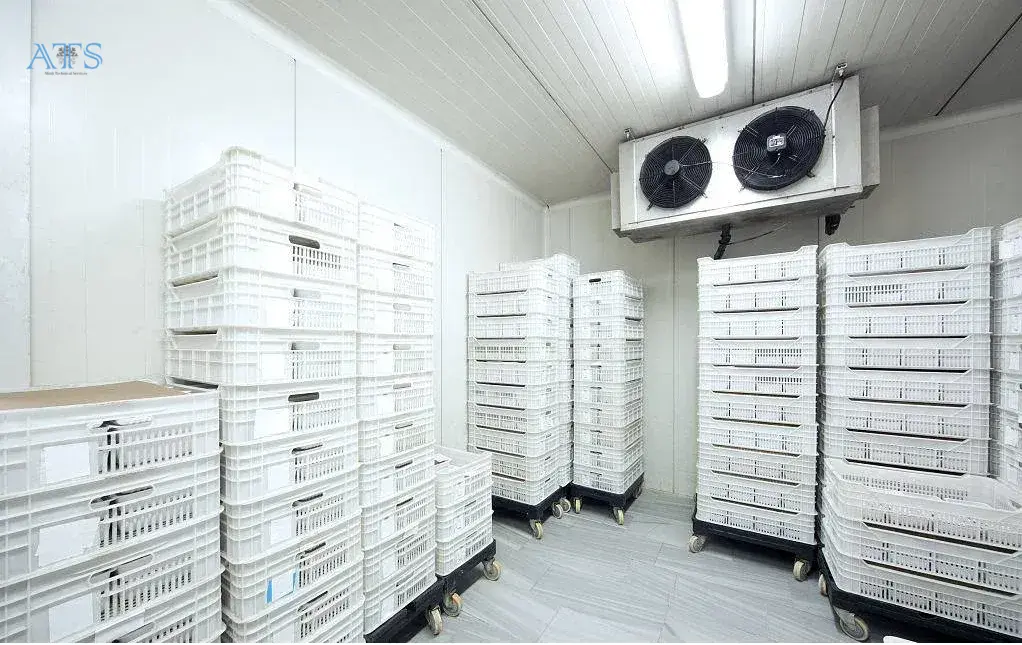
Heat Loads in UAE Cold Storage
In the UAE, a cold store rarely fails on “refrigeration capacity” on paper—it fails in operation because the real heat load profile is uglier than the design assumptions. Ambient temperatures are high for long hours, solar gain is intense, humidity drives latent loads, and logistics patterns create repeated door openings that stack infiltration loads on top of already elevated transmission loads. The result is predictable: higher compressor runtime, unstable room temperatures, excessive defrost demand, and energy costs that don’t match the model.
As a contractor/engineer, I treat heat loads here as a system behavior problem, not a single calculation. You’re not just sizing compressors; you’re Engineering Design on Cold Storage Quality, designing a facility that can absorb load spikes without drifting out of spec, without icing the evaporators, and without pushing suction pressure so low that efficiency collapses.
sAuditors and sophisticated clients won’t ask you to show one number; they’ll ask whether your design captures the real drivers: envelope integrity, infiltration control, defrost strategy, product pull-down, lighting and people loads, and the heat rejection penalty when condensing temperatures stay high. If you can document assumptions, measurement points, and mitigation decisions, you look like a builder of cold stores—not just an equipment installer.
Envelope Transmission: Panels, Roofs, Thermal Bridges, and Solar Reality
In UAE conditions, transmission load isn’t just “U-value × area × ΔT.” Roof exposure and solar gain create surface temperatures that make the envelope behave worse than the spreadsheet implies, especially when roof details (fasteners, purlins, parapets) act as thermal bridges. If the roof is the weak link, the plant will fight a constant base load and never get a comfortable cycling pattern.
Panel selection and installation details matter as much as thickness on the datasheet. Gaps, crushed joints, misaligned cam-locks, and poor vapor sealing become moisture paths then insulation performance degrades and icing/condensation appears at junctions. Once vapor gets into the system, you’re not “slightly less efficient”; you’re on a slow march to chronic maintenance and energy waste.
From a contractor perspective, I push for a documented “envelope integrity package”: approved panel specs, vapor barrier continuity details, thermal bridge minimization, and an inspection checklist with photos at critical junctions (roof-wall, floor-wall, door frames, penetrations). In the UAE, a clean envelope is not aesthetic—it’s your cheapest refrigeration capacity.
Infiltration Loads: Doors, Docks, Airlocks, and Negative Pressure Traps
Infiltration is the silent killer in UAE cold stores because door events are frequent and the outside air is hot and moist. Every uncontrolled door opening injects both sensible heat and a heavy latent moisture load, which shows up later as frost on coils, longer defrosts, and rising fan power. If you only model average door openings, your actual peak load will punish you.
The dock layout drives this load more than many engineers admit. A cold room with a straight shot to the loading bay behaves completely differently from one with an ante-room, air curtain, or rapid-roll door sequencing. Pressure relationships also matter: if the cold space runs negative relative to warmer zones, it will inhale moisture through every crack—even when doors are closed.
Practical mitigation is a combination of hardware and operating rules: fast doors with interlocks, properly designed airlocks, strip curtains where appropriate, dock seals, and a clear traffic plan for forklifts. I also like to see door-cycle logging and temperature/humidity sensors near docks—because in UAE projects, infiltration is usually the biggest gap between predicted and real energy use.
Product Pull-Down & Throughput: The Load You Don’t See in the Building Model
Many “energy models” assume the product arrives near storage temperature. In UAE logistics, that assumption is often false: products sit on warm docks, travel in mixed conditions, or arrive from transport with temperature drift. Pulling product down from a higher entering temperature is a massive load that can dominate nightly operation.
This load is not only about kilowatts; it’s about time constants and control stability. If you have high throughput with frequent product turnover, the room behaves like a process cooler, not a static warehouse. Without a realistic pull-down scenario, you end up with undersized evaporators, aggressive suction pressure drops, and unstable humidity—exactly the conditions that damage packaging and increase dehydration.
As a contractor, I want a simple but honest product profile: daily tonnage, entering temperatures, target core temperatures, allowable pull-down time, and staging practices. If clients can’t provide it, we instrument early: data loggers at receiving, in-room, and discharge air to build the load picture and adjust control/defrost strategy before the site gets blamed for “poor refrigeration.”
Latent Loads, Humidity, and Defrost: Where UAE Heat Loads Become Ice
In the UAE, humidity turns heat load into an ice problem. Moist air infiltration condenses and freezes on evaporator coils, increasing pressure drop, reducing heat transfer, and forcing longer, more frequent defrost cycles. That defrost energy isn’t a rounding error—it’s often a visible chunk of the electricity bill and a real risk to temperature stability.
Defrost strategy has to match the actual moisture load, not a generic schedule. Electric defrost can be clean and controllable but expensive; hot-gas defrost can be efficient but unforgiving if controls and piping are sloppy. Poor defrost termination logic leads to either residual ice (capacity loss) or overheating (product risk and humidity spikes).
The audit-proof way to handle this is to document: coil selection assumptions, target coil face velocity, defrost method, termination sensors, drain heating and routing, and commissioning records showing stable post-defrost recovery. If you can show that defrost was engineered around UAE humidity and door behavior, you’re demonstrating experience not guessing.
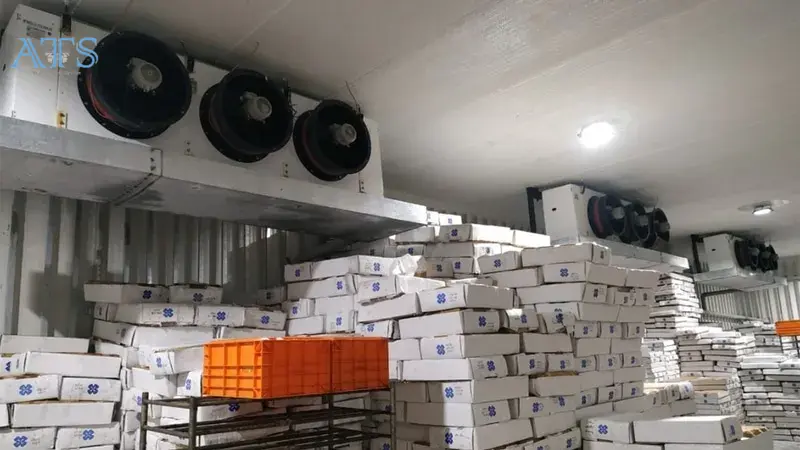
Read More: industrial refrigeration & district cooling systems
Management and monitoring of Industrial Cold Storage with Afzali
A cold storage doesn’t lose money only when it breaks down it loses money when it runs “almost OK.” A few degrees of drift near the doors, a condenser that slowly fouls, defrosts that start taking longer, or sensors that are no longer accurate can quietly push energy consumption up and pull product safety down. In high-throughput facilities, these small instabilities compound into claims, emergency callouts, and permanent OPEX inflation.
Afzali helps industrial cold storage owners move from reactive operation to controlled, measurable performance. We combine practical refrigeration engineering with monitoring discipline: clear setpoints, meaningful alarms, trend-based diagnosis, and maintenance actions that are triggered by data not by guesswork. The objective is simple and commercial: stable temperature compliance, lower operating cost, and fewer surprises.
Instead of selling “a dashboard,” Afzali delivers an operating system for your cold store: what to measure, where to measure it, how to interpret it, and what actions to take when performance starts to drift. The result is a facility that operators can run confidently and managers can audit, report, and improve month after month.
What Afzali Monitors (So You Control the Real Drivers)
Afzali’s monitoring scope is designed around the parameters that actually determine performance in industrial cold storage not generic building metrics. Typical monitoring points include room temperature stability (including risk zones near doors), evaporator behavior (fans, coil condition, defrost cycles), door events that drive infiltration, and rack-side signals when available (suction/condensing trends, compressor stages, alarms). This structure lets you see the real root causes behind high energy bills: excessive infiltration, rising head pressure, incorrect defrost strategy, or sensor drift. This is also where monitoring becomes a marketing-grade deliverable for your business: with proper logs and trends, you can prove compliance to customers, insurers, and auditors rather than debating it after an incident.
Operational Management: Alarms, Escalation, and Clear Responsibilities
Many cold stores fail operationally because alarms exist, but ownership doesn’t. Afzali implements a practical alarm philosophy: what is informational, what needs operator action, what triggers escalation, and what must protect the plant automatically. When alarms are structured and actionable, teams respond faster, nuisance alarms fall, and real events stop being buried in noise.
We also align monitoring with a simple operational rhythm: daily checks, weekly trend review, monthly performance reporting, and a controlled process for handling excursions (deviation workflow). This turns monitoring into a management tool not a screen that everyone ignores.
Energy Optimization That Operators Can Actually Execute
Cold store energy savings rarely come from “one big upgrade.” They come from controlling the basics continuously: condensing pressure discipline, clean heat rejection, stable suction control, infiltration reduction, and defrost optimization. Afzali’s approach links energy KPIs directly to actions so your team knows what to do when a KPI drifts.
Examples of actionable KPIs include energy intensity (kWh per pallet-day or per ton handled), defrost minutes per evaporator per day, and head pressure trends versus ambient. When these are tracked and reviewed, OPEX stops being a mystery and becomes a controllable variable.
Maintenance Integration: PM That Prevents Drift (Not Just Breakdowns)
A cold store can be “not broken” and still be inefficient. Afzali connects monitoring to preventive maintenance: coil cleaning triggers, sensor calibration intervals, door heater and drain checks, fan health, and trend-based indicators that identify failures early. This reduces emergency callouts and protects capacity during peak seasons.
Just as important, it produces documentation: maintenance logs, calibration records, and event timelines. For industrial cold storage operators, this evidence is often the difference between a manageable issue and a costly dispute.

No Comments
Sorry, the comment form is closed at this time.